Assistant Research Professor at Cornell University
davidliu@cornell.edu
I am an Assistant Research Professor at Cornell’s Center for Data Science for Enterprise and Society, where I am mentored by Jon Kleinberg, Maryam Fazel, and Sarah Dean. I am also a faculty affiliate of Cornell’s Center on Democracy.
The goal of my research is to better measure and learn human preferences with and for AI. Specifically, I am interested in measuring multidimensional preferences, understanding how preference data from various social groups interact, and increasing user agency via feedback. My work spans applications to recommender systems, ranked-choice voting, and algorithmic fairness.
I completed my Ph.D. in computer science at Northeastern University, where I was affiliated with the Network Science Institute and supported by the NSF GRFP. I graduated summa cum laude with a Bachelor of Science in Engineering from Princeton University.
Previously, I worked as a research scientist intern at Meta (Central Applied Science and FAIR AI), a sociotechnical researcher at Taraaz, and a software engineer at Bloomberg LP.
News
Jul '26
Presented work on polling for ranked-choice voting at EC 2026 (New Directions in Social Choice workshop).
Jul '26
Presented work on data mixing for collaborative filtering at ICML 2026 (Pluralistic Alignment workshop).
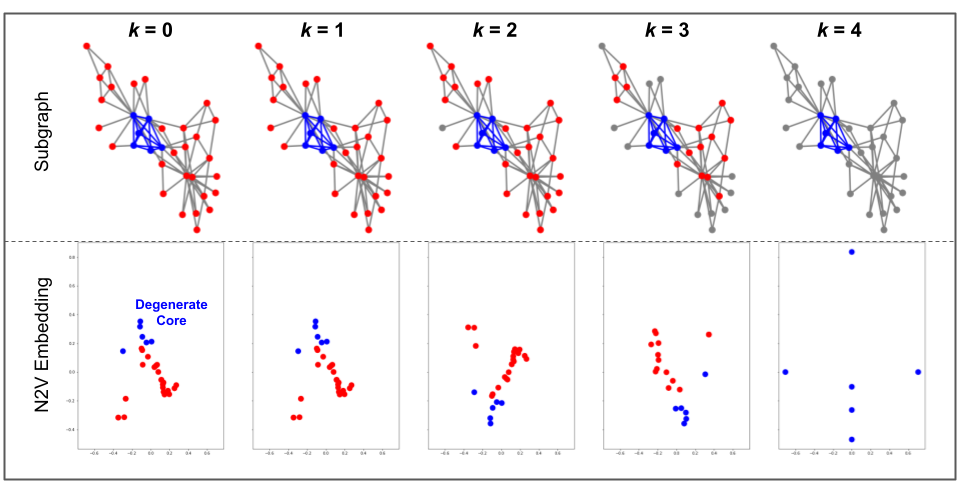
Are the embeddings of a graph’s degenerate core stable? What happens to the embeddings of nodes in the degenerate core as we systematically remove periphery nodes (by repeatedly peeling off k-cores)? We discover three patterns w.r.t. instability in degenerate-core embeddings across a variety of popular graph embedding algorithms and datasets. We correlate instability with an increase in edge density, and then theoretically show that in the case of Erdős–Rényi model graphs embedded with Laplacian Eigenmaps, the best and worst possible embeddings become less distinguishable as density increases. Furthermore, we present the STABLE algorithm, which takes an existing graph embedding algorithm and makes it stable. We show the effectiveness of STABLE in terms of making the degenerate-core embedding stable and still producing state-of-the-art link prediction performance.
We measure stability of node embeddings by iteratively shaving off k-shells and re-embedding the graph. Instability is defined as perturbations to the embeddings of the degenerate core (k-core with maximum k) as the periphery is removed. The above example uses the Zachary Karate Club network and the Node2Vec embedding algorithm.
VDS at IEEE VIS ’22
BiaScope: Visual Unfairness Diagnosis for Graph Embeddings
Agapi
Rissaki*, Bruno
Scarone*, David
Liu, Aditeya
Pandey, Brennan
Klein, Tina
Eliassi-Rad, and Michelle A.
Borkin

 A Guiding Framework for Vetting Technology Vendors Operating in the Public Sector2023A research report conducted with Taraaz and the Ford Foundation to assist the public sector in vetting technology vendors.